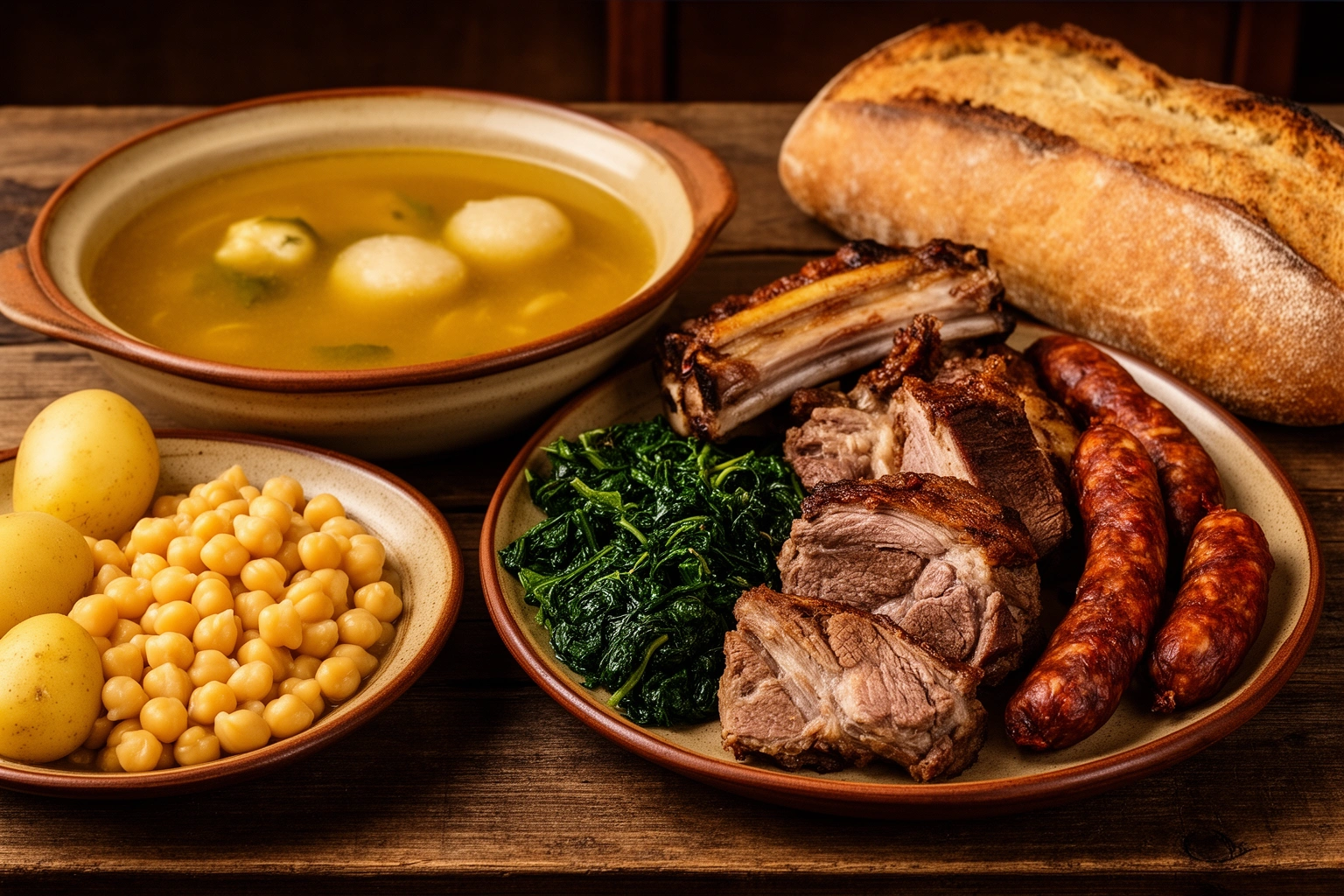
Cocido gallego is not a stew you order and receive in ten minutes. The dish is a meal structure, a cultural event compressed into a pot: first the broth arrives in a wide bowl, golden and fatty and deeply savory from hours of simmered pork bones. Then come the chickpeas and potatoes, soft and infused with everything the liquid has absorbed. Finally, the meats: lacón falling off the bone, chorizo sliced thick, spare ribs, pig ear, smoked ham shank. Every part of the pig finds its role. The searching for the best cocido gallego near me isn’t a casual hunger decision. It’s an intentional choice to track down one of northwestern Spain’s most substantial culinary traditions.
The challenge in the US is real: this is a hyper-regional Galician dish, not a pan-Spanish menu staple. Most people who’ve eaten it discovered it in Spain, probably during winter, probably at a family table in Galicia or at the annual Cocido Festival in Lalín, and they’ve been looking for it in their home city ever since. Finding a version that honors the original requires knowing which cities have the right restaurant infrastructure, which ingredients define an authentic preparation, and which red flags signal a simplified imitation. This guide covers all of it.
What Cocido Gallego Actually Is (and What Makes It Different)
Cocido gallego is a three-course pork feast from Galicia in northwestern Spain, served as separate stages: broth first, then vegetables and chickpeas, then a full platter of slow-cooked meats including lacón, chorizo, spare ribs, and smoked ham shank.
The word “cocido” simply means “cooked” in Spanish. The same name covers a dozen regional variations across the country, from the Madrid version built on chickpeas and beef to the Andalusian variation with vegetables and little meat. Cocido gallego stands apart by its reliance on the pig in near-totality. The dish traces directly to the November matanza, the annual pig slaughter that defined the Galician agricultural calendar for centuries. Every part of the animal was either eaten immediately or salted for preservation. Cocido was the winter meal built from those preserved cuts: the salted lacón (the cured foreleg, less prized than jamón but transformed by long boiling into smoky, yielding chunks), pig ears, spare ribs, snout when available, and smoked shank. Chorizo added paprika-forward spice. Grelos (Galician turnip greens with their own denomination of origin) added bitterness to cut the fat. Chickpeas and potatoes absorbed the broth.
The serving structure is not optional in traditional preparation. Broth comes first, often ladled over a piece of bread at the bottom of the bowl. The chickpeas and potatoes follow. The meats arrive last on a shared platter, cut into equal pieces, served family-style. Restaurants that dump everything into a single bowl simultaneously are collapsing a three-act meal into one course, which changes the experience fundamentally. Authentic cocido gallego is a long, communal, unhurried affair. A family cocido in Lalín can run three to four hours before dessert.
The Ingredients That Define an Authentic Version
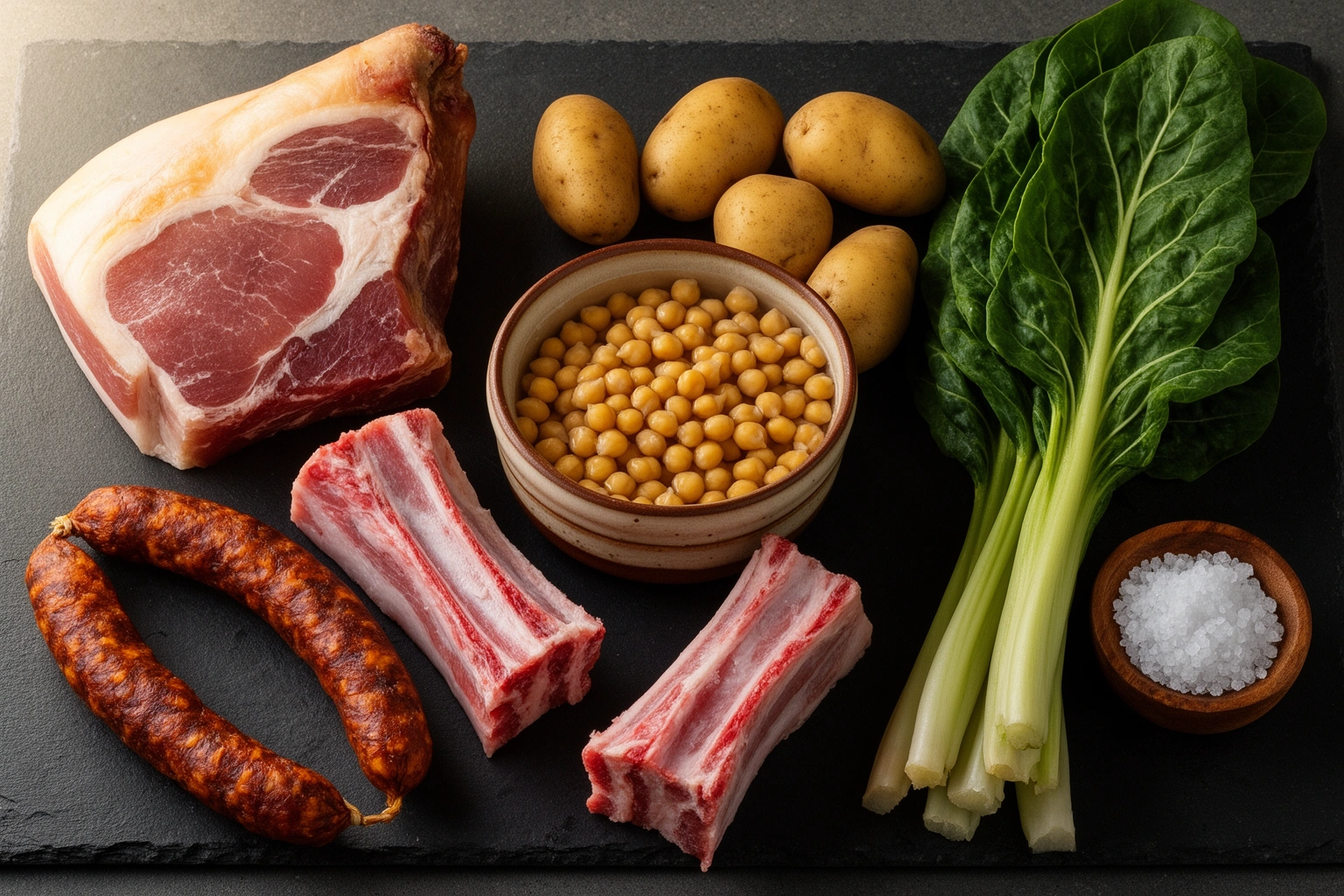
Remove lacón, grelos, or proper chickpeas from cocido gallego and the dish loses its Galician identity. These three components are non-negotiable markers of authenticity.
Lacón
Lacón is the cured pork foreleg, processed similarly to jamón but from the front leg rather than the hind. It is tougher, less marbled, and unsuitable for thin slicing and room-temperature eating. That is exactly why it goes into cocido: long boiling breaks down its connective tissue into smoky, falling-apart chunks that carry deep pork flavor into the broth. Restaurants outside Spain often substitute smoked pork neck, smoked ham hock, or pork shoulder. These work reasonably well, but a kitchen that sources actual lacón from a Spanish importer signals genuine commitment to the dish.
Grelos
Grelos are the turnip greens specific to Galicia, harvested in late winter and carrying their own Denominación de Orixe Protexida. Their flavor is slightly bitter and mineral, distinct from kale, collard greens, or generic turnip tops available elsewhere. Most US restaurants use collard greens or cavolo nero as a substitute, which is acceptable. What matters is the function: a bitter, assertive green that counterbalances the fat load of the pork platter. Any version that uses spinach or Swiss chard instead is making a significant flavor compromise.
Chickpeas, Not White Beans
This is a frequent confusion because caldo gallego, the lighter Galician soup, often uses white beans. Cocido gallego uses chickpeas (garbanzos), soaked overnight, cooked in the pork broth until creamy and saturated with smoky fat. Restaurants that serve white beans and call it cocido gallego are either confusing the two dishes or substituting because chickpeas require more preparation time. Both are Galician. They are not the same dish.
The Full Pork Roster
Traditional cocido gallego uses multiple cuts simultaneously: spare ribs for fattiness and body, pig ear for collagen and texture, smoked ham shank for depth, chorizo for paprika heat, and lacón for the centerpiece. Every cut serves a different textural and flavor function. Kitchens that reduce this to “pork shoulder and chorizo” are streamlining a multi-dimensional dish into something much simpler.
Caldo gallego is a lighter white-bean soup with greens and a small amount of pork for flavor. It’s a daily meal, simple and fast. Cocido gallego is an entire feast requiring multiple hours of preparation, multiple pork cuts, chickpeas, and three separate courses. When searching for cocido near you, confirm that the menu means the full multi-course version, not the soup.
Where in the US to Actually Find Cocido Gallego
New York City has the most reliable concentration of Galician and Spanish restaurants in the United States, with a handful of kitchens that serve cocido in at least seasonal rotation.

New York City
New York carries the strongest Spanish and Galician restaurant infrastructure in the country. Tomiño Taberna Galega in Lower Manhattan (Nolita/Chinatown border) is the most explicitly Galician restaurant in the city, with a menu built around Galicia-specific dishes including pulpo á feira, empanada gallega, and seasonal specials that include cocido in winter months. Phil Gonzalez, one of the people running Tomiño, has publicly spoken about pairing cocido with light-bodied Galician reds like Goliardo Tinto from Rías Baixas or Escolma Tinto from Ribeiro, confirming the kitchen’s engagement with the dish at a serious level.
Casa Galicia in Astoria, Queens, is another frequently cited spot by people looking for traditional Galician cooking. The restaurant has a long history in the city’s Spanish emigrant community and serves cocido as a periodic special. La Nacional on West 14th Street claims the title of oldest Spanish restaurant in New York, having operated since 1868, and still serves traditional Galician and Spanish dishes with old-school commitment. Neither La Nacional nor Casa Galicia runs cocido as a permanent menu item: it appears as a weekend special or winter seasonal, so confirming availability before visiting is necessary.
Miami
Miami’s Spanish community and Cuban-Spanish culinary crossover makes it the second-best US city for finding cocido gallego. Spanish social clubs in the Miami area have historically been the most reliable source of traditional communal dishes like cocido: organizations like Círculo Cubano or Spanish cultural associations occasionally host cocido dinners, particularly around the winter months when the dish is seasonally appropriate. Pura Vida, which operates several Miami locations focused on Spanish and Mediterranean food, has been mentioned in local food communities as a source for cocido when it appears on their rotating menu.
Tampa
Tampa’s Ybor City neighborhood carries a century-old Spanish immigrant community, primarily Asturian and Galician, that established mutual aid societies and social clubs still operating today. The Columbia Restaurant, opened in 1905 and still family-owned, is the most famous Spanish restaurant in Florida and serves traditional Spanish dishes including regional stews. Tampa’s Spanish heritage runs deeper than most US cities outside New York, making it worth investigating specifically for cocido availability at Spanish social clubs and family-run tabernas in the Ybor City area.
Los Angeles and Chicago
Both cities have Spanish restaurants capable of serving cocido gallego, but the dish appears less reliably than in New York, Miami, or Tampa. In Los Angeles, Spanish-owned restaurants in Silver Lake and the Westside that cater to expatriate communities are the best targets. In Chicago, River North and Lincoln Park have Spanish-focused restaurants that periodically feature regional stews on winter menus. In both cities, the approach is the same: search for explicitly Galician or northern Spanish restaurants rather than general Spanish or Mediterranean spots, and call ahead to confirm cocido availability before committing to a visit.
How to Identify a Kitchen That Takes Cocido Gallego Seriously
The single most reliable indicator: cocido gallego is a seasonal or weekly special, never a daily permanent menu item. Any restaurant listing it as an always-available dish either prepares it in bulk in advance or has simplified the recipe to the point where it no longer requires traditional slow cooking.
Questions That Reveal Kitchen Commitment
Three questions separate serious kitchens from those serving a simplified approximation. First: “What pork cuts does your cocido use?” An authentic version should name multiple cuts, including at minimum lacón or smoked pork foreleg, chorizo, and spare ribs. A kitchen that says “pork shoulder and sausage” has reduced the dish. Second: “Is it served in courses?” A kitchen that serves broth separately from the meats understands what cocido gallego is. One that brings everything in a single bowl treats it as a regular stew. Third: “Which days do you serve it?” Any answer that isn’t a specific day or season signals either daily batch cooking from frozen portions or a kitchen that hasn’t thought carefully about the dish.
Review Language That Signals Quality
When reading reviews on Google Maps or Yelp, filter by searching “cocido” within the restaurant’s review section. Look for language describing the broth as rich or golden, mentions of multiple meat cuts arriving on a shared platter, and any specific mention of grelos or lacón. Spanish or Galician-diaspora reviewers who compare the restaurant’s version to what they ate growing up are the most reliable signal of authenticity. Conversely, reviews that describe cocido as “a hearty chicken-and-vegetable soup” or “similar to beef stew” indicate the kitchen has drifted far from the original.
Timing: When to Search and When to Call
Cocido gallego is a winter dish by tradition. In Galicia it runs from January through the beginning of Lent. In the US, Spanish restaurants with genuine commitment to the dish tend to feature it October through March. Searching during summer months will almost always come up empty. The most reliable approach: identify candidate restaurants in September, call in October to confirm their plans for the season, and make a reservation for a weekend lunch service, which is when most Spanish restaurants run their most labor-intensive traditional dishes.
| Quality Marker | Authentic Version | Simplified Version |
|---|---|---|
| Service structure | Three courses: broth, then veg/chickpeas, then meats | Everything in one bowl simultaneously |
| Pork cuts | Lacón, spare ribs, pig ear, chorizo, smoked shank | Pork shoulder and one type of sausage |
| Legumes | Soaked chickpeas, creamy and pork-infused | White beans or canned chickpeas |
| Greens | Grelos or collard greens, bitter and assertive | Spinach, chard, or omitted entirely |
| Availability | Seasonal or specific-day special | Always on the menu year-round |
| Broth color | Deep golden, faintly fatty, smoky undertone | Pale, watery, or tomato-red |
Lalín: The Spiritual Home of Cocido Gallego
The town of Lalín in the Galician province of Pontevedra hosts the annual Cocido Festival, widely regarded as the dish’s spiritual home and highest expression. The festival runs each February with a parade of floats dedicated to individual cocido ingredients, a live meat auction, and a pig mascot named Son de Lalín who wears a sign reading “I’m From Lalín.”
Understanding Lalín matters even for US diners searching locally, because it establishes the standard against which all versions are measured. A cocido in Lalín is a 30-person communal lunch that begins with anchovies, cheese, bread, olives, and cured ham before the cocido itself arrives. Then plate after plate of pork cuts comes down the table alongside garbanzos, boiled potatoes, grelos, chorizo, and hunks of bread to absorb the broth pooling at the plate’s edges. Wine pours continuously. The meal extends for hours before dessert, coffee, and typically a nightcap.
This context explains why the dish is so difficult to replicate outside Galicia. Cocido gallego is not just a recipe: it is a format, a pacing, and a social structure. The best US versions capture the cooking correctly. The communal experience surrounding it is harder to recreate in a restaurant setting, which is why some of the most authentic US cocido experiences happen not in restaurants but at Spanish cultural club dinners and private events where the Galician community gathers specifically around this dish.
Wine Pairings: What Galician Sommeliers Actually Recommend
The fat content of cocido gallego demands wines with high acidity that cut between bites and refresh the palate. Heavy tannic reds compete with the pork and make the meal feel heavier than it already is.
Carlota Cabanas, sommelier at Restaurante Cabanas in Lalín (the dish’s hometown), recommends Caíño Tinto, specifically Bodegas Albamar’s ‘Ancestral’ bottling, for its ability to cut through fatty meats and reset the palate for the next bite. Phil Gonzalez of Tomiño Taberna Galega in New York City points to two options: Rodri Mendez’s Goliardo Tinto (light-bodied, high acid, low alcohol from Rías Baixas) for those who want the lightest pairing, or Luis Anxo Rodriguez’s Escolma Tinto from Ribeiro for something rounder while still acid-forward.
The general principle, articulated by Óscar Gil of Viños Manuel Gil in Lalín: choose a wine with good acidity that cuts through fat, not a heavy tannic red that competes with it. A Ribeiro red is the most traditional regional match. Manzanilla or fino Sherry works brilliantly for those open to it: the saline, oxidative character of both cuts pork fat with remarkable efficiency. Albariño, Galicia’s most famous white, handles the broth course especially well before transitioning to red for the meat platter.
Making Cocido Gallego at Home When You Can’t Find It Nearby
Home cocido gallego is a half-day project, not a weeknight meal. The method is straightforward but the time commitment is non-negotiable: the chickpeas need overnight soaking and the pork needs 90 to 120 minutes of simmering before the dish is ready.
The night before: soak a bag of dried chickpeas in cold water. The morning of: fill the largest pot you own with water and bring it to a boil. Add the soaked chickpeas (in a tied cheesecloth if available, to keep them contained). Add all pork cuts except the chorizo: spare ribs, pig ears, smoked pork neck or lacón equivalent, ham bone. Cook at a medium simmer for 90 to 120 minutes, removing each cut as it becomes fork-tender, starting with the ears and ending with the ribs.
In a separate pot, cook the collard greens and potatoes with a small knob of lard and the chorizos on top. Both pots run simultaneously in the second hour. When the greens and potatoes are tender (about 20 to 30 minutes), everything is done. Serve the broth first in wide bowls. Then the chickpeas and potatoes. Then the meats on a large shared platter, cut into equal pieces. The lacón or pork neck goes in the center. Chorizo slices around the perimeter. Ears and ribs in between.
Sourcing is the hardest part outside major cities. Smoked pork neck (available at Greek and Eastern European delis) substitutes adequately for lacón. Pig ears are available at many butcher shops, Asian grocery stores, and Mexican carnicerías. Collard greens replace grelos without significant flavor compromise. Dried chickpeas are available everywhere. The result, even with substitutions, is substantially closer to authentic cocido gallego than anything a simplified restaurant version might produce.
Check These Related Articles
- The Invisible Infrastructure of Learning: Zlibrary Official Domain
- A Real Himalayan Journey Guide: Langtang Valley Trek and 7-Day Annapurna Base Camp Trek
- Navigating Travel and Venue Logistics for a Destination Wedding in Japan
- Why Phu Quoc Is Fast Becoming the Ultimate Luxury Escape in Southeast Asia
- Resilience as an Inherited Skill
The same patience required to track down cocido gallego in the US applies to planning a serious culinary trip to Spain or Galicia. Our guide to navigating destination travel logistics covers how to plan international trips around experiences, not just venues, which applies equally to scheduling a February trip to Lalín around the Cocido Festival.
Galicia sits in a part of northwestern Spain that shares a green, rainy, oceanic climate with destinations like Vietnam’s highlands. Anyone who appreciates the depth of regional cuisine in places like Phu Quoc in Southeast Asia will find Galicia similarly rewarding: a region where landscape, agriculture, and food culture are inseparable.
Cocido gallego is ultimately a dish about inheritance and memory. The Galician concept of morriña, the specific nostalgia for Galicia felt by those who’ve left, finds its edible form in this pot. Resilience passed through generations shows up in food as much as anywhere else: the matanza tradition, the salt-curing, the cocido itself, were all survival strategies that became cultural identity over centuries.
Frequently Asked Questions
What is cocido gallego?
Cocido gallego is a traditional multi-course pork feast from Galicia in northwestern Spain. It includes slow-cooked lacón, chorizo, spare ribs, pig ear, smoked ham shank, chickpeas, potatoes, and grelos, served in three stages: broth first, then vegetables and chickpeas, then a shared platter of meats.
What is the difference between cocido gallego and caldo gallego?
Caldo gallego is a lighter soup made with white beans, greens, and a small amount of pork for flavor. Cocido gallego is a full three-course feast using multiple pork cuts and chickpeas, served over several hours. They are different dishes from the same region.
Where can I find cocido gallego near me in the US?
New York City has the most reliable options, including Tomiño Taberna Galega in Nolita, Casa Galicia in Astoria, and La Nacional in Manhattan. Miami, Tampa, Los Angeles, and Chicago also have Spanish restaurants that serve it seasonally. Always call ahead to confirm availability as it is typically a winter or weekend special.
What is lacón and why does it matter in cocido gallego?
Lacón is the cured foreleg of the pig, similar to jamón but from the front leg. Long boiling breaks it into smoky, tender chunks that give cocido its depth. It is a defining ingredient of authentic Galician cocido. Kitchens that source actual lacón from Spanish importers take the dish seriously.
What are grelos and can anything replace them?
Grelos are Galician turnip greens with their own protected designation of origin. Their bitter, mineral flavor counterbalances the fat-heavy pork platter. US restaurants substitute collard greens or cavolo nero, which work well. Spinach or chard are less satisfying substitutes as they lack the necessary bitterness.
Is cocido gallego served year-round?
Traditionally no. Cocido gallego is a winter dish, eaten from January through the beginning of Lent in Galicia. In the US, authentic versions appear on menus from October through March. A restaurant serving it year-round is likely using pre-made batches rather than slow-cooking it fresh to order.
What wine pairs best with cocido gallego?
Light-bodied, high-acid Galician reds are the classic pairing: Caíño Tinto, Ribeiro reds, or Rías Baixas Tinto. Manzanilla or fino Sherry also works well. Avoid heavy tannic reds, which compete with the fat of the pork rather than cutting through it.
Where is the best cocido gallego in the world?
The town of Lalín in the Galician province of Pontevedra is considered the dish’s spiritual home and hosts the annual Cocido Festival each February with parades, a meat auction, and a community feast. Restaurante Cabanas in Lalín is one of the most cited destinations for the definitive version.