You might be feeling pulled in two directions right now. On one side, there is the contract you counted on, the deal that looked clear enough when everyone signed. On the other, there is the silence, the missed payment, the unfinished work, or the sudden claim that the other side never meant what the contract says. Before the breach, the agreement may have felt like security. After the breach, it can feel like the ground moved under your feet. In moments like these, commercial and corporate lawyers can help you understand your position and next steps.
That stress is real, especially when money, deadlines, employees, or your reputation are tied to the outcome. The short answer is that if you are dealing with a breach of business contract in New Jersey, the law may allow several remedies, including money damages, contract cancellation in some cases, and court orders that require a party to act or stop acting. The right remedy depends on what was promised, what was lost, and what proof you can gather now.
When a business contract is broken, what does New Jersey law usually allow?
A broken contract is not always dramatic at first. Sometimes it starts with a late delivery that turns into a lost customer. Sometimes a vendor keeps asking for more time, while your own obligations keep piling up. Because of this tension, you might wonder whether every broken promise is legally actionable. The answer depends on whether there was a valid contract, whether one side failed to perform, and whether that failure caused measurable harm.
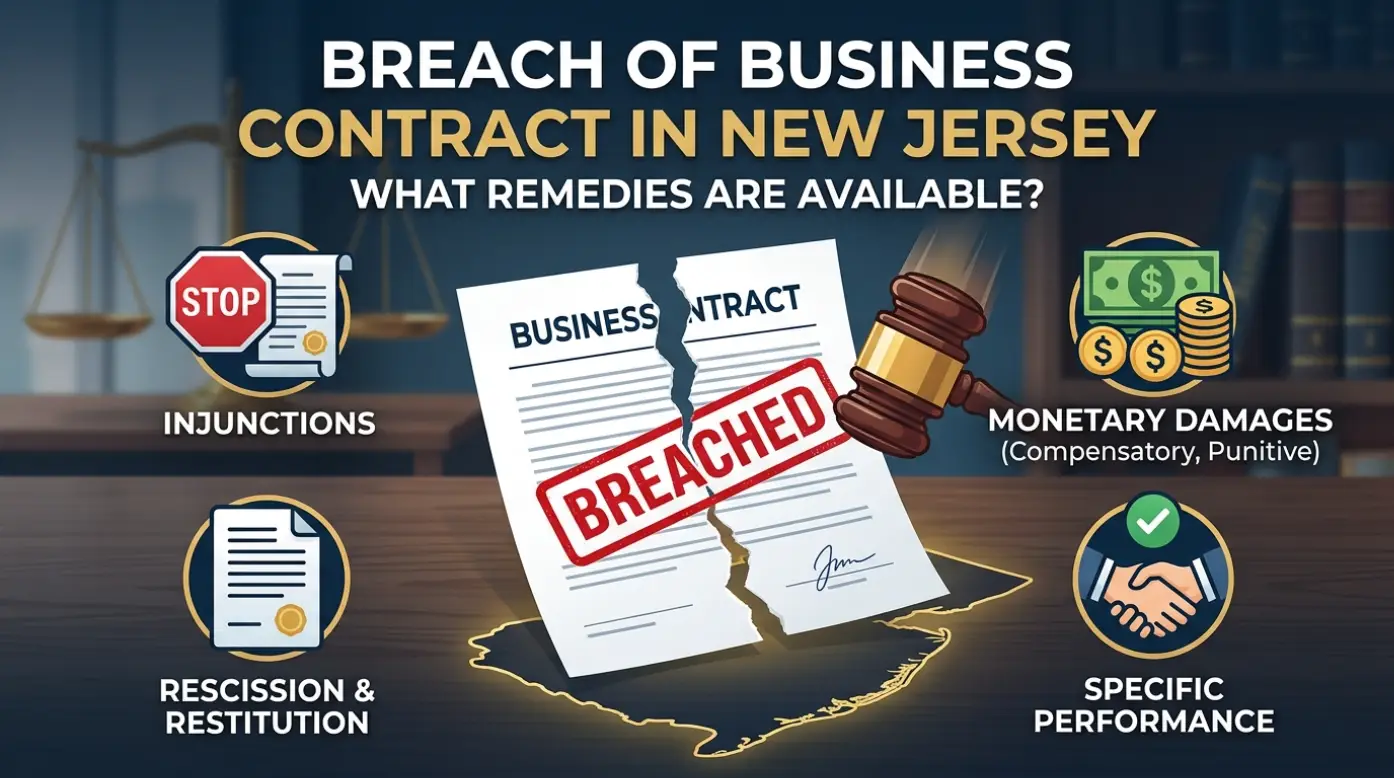
In many cases, the main remedy is damages. That means money meant to put you in the position you would have been in if the contract had been honored. In plain terms, if you paid for services that were never delivered, or if a supplier’s breach caused you to lose revenue, the court may award compensation tied to those losses. New Jersey courts give guidance on contract damages, and you can review the state’s civil jury charge on contract damages to see how these claims are framed.
There are other options too. If the breach is serious enough, rescission may be available. That means the contract is undone, and the parties are restored as closely as possible to where they were before the deal. In some cases, a court may also award restitution, which focuses on returning a benefit unfairly kept by the other side.
And what if money alone does not fix the problem? If the subject of the contract is unique, a court may consider specific performance. That is a court order requiring a party to carry out its promise. This is more common in certain property disputes than in ordinary service contracts, but it can matter when the thing promised cannot easily be replaced.
Why can a contract dispute in New Jersey become so costly so quickly?
A contract dispute in New Jersey often grows beyond the original disagreement. A missed payment can interrupt payroll. A failed delivery can trigger your own breach with someone else. A broken noncompete or confidentiality clause can affect clients you spent years building. What looked like one problem can become three or four, and each one may need proof.
This is where many business owners get stuck. They know something went wrong, but they are not sure how to measure the damage. Can you claim lost profits? Maybe, but they usually must be proven with reasonable certainty. Can you recover attorney’s fees? Only if the contract or a law allows it. Can the other side argue that you failed to reduce your losses? Yes, and that issue comes up often. If a practical substitute was available and you did nothing, the court may ask why.
So, where does that leave you? It leaves you needing a clear record of what the contract required, what actually happened, and what the breach cost you. Emails, invoices, change orders, payment records, text messages, and internal notes can all matter. Even a timeline written while events are still fresh can help.
Should you handle a business contract breach on your own or get legal help?
Some disputes can be resolved through direct negotiation, especially when the amount at stake is limited and both sides still want to preserve the relationship. But if the facts are disputed, the losses are growing, or the other side has already involved counsel, trying to manage a breach of contract remedies claim alone can create risk.
| Approach | When it may work | Main risk | Possible upside |
|---|---|---|---|
| Direct negotiation | Clear breach, limited damages, ongoing business relationship | Saying too much too soon or accepting too little | Fast resolution with lower cost |
| Demand letter with legal support | Strong documents, serious but still fixable dispute | Other side may still refuse or delay | Shows the claim is organized and supported |
| Filing a civil lawsuit | Large losses, repeated nonperformance, disputed facts | Time, expense, and uncertainty | Access to discovery, court remedies, and enforceable judgment |
If you are trying to understand court process basics, the New Jersey courts provide civil case FAQs and self help materials that explain filing and procedure in simple terms. Those resources can help you get oriented, even if your case later needs deeper legal analysis.
What can you do right now if a business agreement has been breached?
1. Gather the full contract file.
Pull the signed agreement, amendments, invoices, emails, texts, and proof of payment into one place. If performance changed over time, collect those communications too. Many cases turn on details outside the main contract document.
2. Build a timeline and calculate your losses.
Write down the key dates, what each side was supposed to do, what happened instead, and how that affected your business. Include direct losses, replacement costs, delays, and any lost revenue you can support with records.
3. Avoid emotional messages and protect your position.
It is tempting to send one last angry email, especially if you feel cornered. Try not to. Keep communications calm, factual, and short. If the dispute is growing, get legal guidance before making concessions, terminating the contract, or threatening suit.
How do you move forward after a breach of business contract in New Jersey?
When a contract breaks down, it can feel personal, even when it is business. You trusted the deal, planned around it, and now you are left cleaning up the fallout. Still, you do have options. A claim for damages, rescission, restitution, or in some cases specific performance may help you recover what was lost and protect what comes next.
The key is to act before records disappear and positions harden. If you are facing a breach of business contract in New Jersey, take stock of the documents, map out the harm, and get clear on the remedy that actually fits the problem. Steady steps now can put you in a much stronger place later.